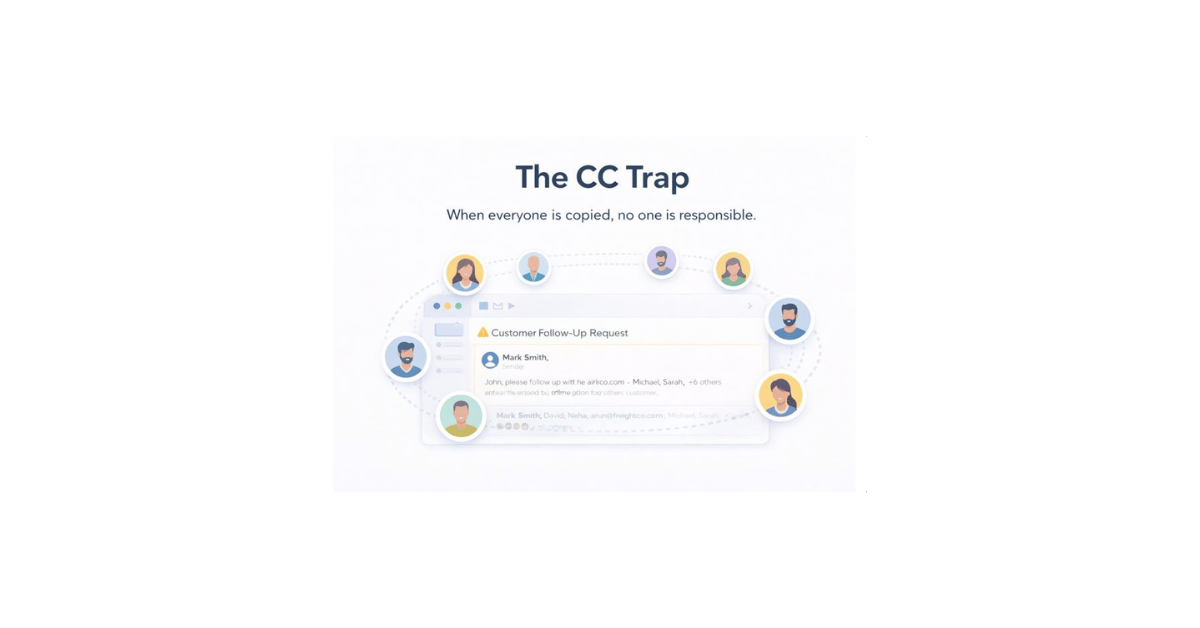


The CC trap: how freight teams lose accountability without realizing it
In freight forwarding, almost every problem leaves behind the same digital footprint:
An email.
With many people CC’d.
And no one clearly responsible.
It doesn’t look like a failure at first.
It looks like transparency.
But over time, it becomes one of the most dangerous habits in freight operations — what we call the CC Trap.
CC creates visibility. Freight needs ownership.
CC culture usually starts with good intentions.
A manager wants everyone informed.
An ops executive wants backup.
A team wants to avoid blame.
So more people are added.
More groups are copied.
More threads grow longer.
Eventually, every important email reaches everyone.
And that’s exactly when accountability quietly disappears.
Because when everyone is copied, no one is clearly responsible.
How the CC Trap damages freight operations
The CC Trap doesn’t create chaos instantly.
It works slowly.
Here’s what it changes inside freight teams:
• Replies become delayed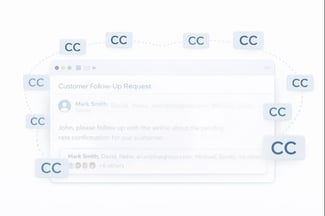
• Follow-ups become assumptions
• Critical emails sink without closure
• Customers start chasing updates
• Internal escalations increase
• Teams feel “busy” but lose control
Not because people don’t care.
But because inboxes were never built to assign operational responsibility.
They were built to deliver messages.
Freight work doesn’t run on messages.
It runs on ownership.
The dangerous psychology of CC
CC creates a false sense of safety.
“If something goes wrong, at least everyone saw it.”
But operationally, CC often produces the opposite outcome:
• Everyone waits
• No one acts
• Important threads age silently
• Problems surface only when customers escalate
At that point, the damage is already done.
Delays.
Lost trust.
Extra calls.
Emergency damage control.
All starting from a single unowned email.
Why freight is especially vulnerable
Freight forwarding is uniquely exposed to the CC Trap because:
• Work is exception-driven
• Emails trigger physical actions
• Many teams touch one shipment
• Timelines are unforgiving
• Mistakes are expensive
In this environment, clarity of responsibility is not a “process improvement.”
It is a survival requirement.
And yet, most freight inboxes still operate like personal mailboxes — not operational control systems.
What high-performing freight teams do differently
High-performing freight teams don’t try to reduce emails.
They redesign how emails are handled.
They ensure that:
• Every important email has an owner
• Threads are assigned, not just read
• Follow-ups are system-driven, not memory-driven
• Visibility supports responsibility — not replaces it
• Inbox becomes an operations surface, not a message dump
The shift is subtle.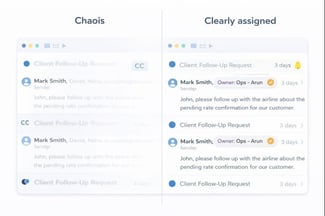
But the effect is massive.
Because now:
Nothing is “someone else’s problem.”
Nothing silently ages.
Nothing survives without accountability.
The real fix isn’t “better habits”
Most teams try to fix the CC Trap with rules:
“Please don’t CC everyone.”
“Always reply all.”
“Mark urgent.”
“Follow up manually.”
These never scale.
Because volume always wins against discipline.
The real fix is infrastructure.
Systems that:
• assign emails
• track ownership
• monitor unanswered threads
• surface forgotten conversations
• make accountability visible
Only then does clarity become natural.
Not forced.
The future of freight inboxes
Freight inboxes are quietly evolving.
From: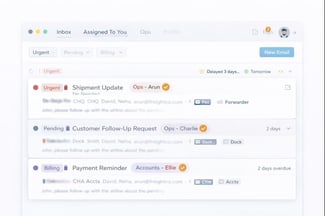
Communication tools
Into:
Operational control layers.
Where emails are not just read — they are owned.
Where nothing critical can hide.
Where responsibility is explicit.
Where follow-ups are engineered.
And where freight teams finally regain control over the one system that touches every shipment: the inbox.
Final thought
If your freight operation depends on emails, then your inbox is already part of your infrastructure.
The only question is:
Is it designed for visibility…
Or for accountability?
