


Introduction
In freight forwarding and logistics, email isn’t just communication — it’s the control tower of your entire operation.
Bookings, airline updates, customer escalations, DO copies, CHA coordination, invoices — everything flows through the inbox.
But there’s a hidden inefficiency inside this inbox that very few freight companies measure: Email context switching.
It’s the silent killer of productivity, response time, revenue, and even team morale.
And it happens hundreds of times a day.
What is email context switching?
Context switching is the mental load your team experiences when jumping between different types of emails.
Example: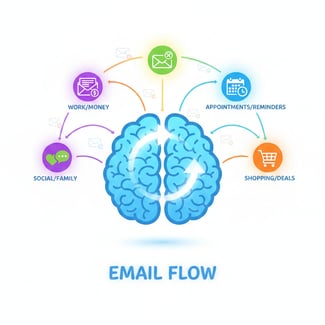
-
Responding to a customer escalation
-
Switching to an airline delay update
-
Switching again to a CHA document query
-
Switching again to a billing follow-up
Each switch forces the mind to restart, re-focus, and re-process information.
In logistics — where every email is high stakes — the cognitive load is even higher.
Why freight teams experience 3x more context switching than other industries
1. Email is the workflow
Other industries use project management tools.
Freight teams use email as the workflow backbone.
2. Shipment lifecycle create unpredictability
No two shipments move the same way, meaning inbox priorities constantly shift.
3. Stakeholders are fragmented
Airlines
Shippers
CHA agents
Transporters
Finance teams
Internal ops
Each sends different email formats, tones, and urgency levels.
4. Volume is extremely high
A single forwarder handles 150–300 emails daily.
Teams handle thousands.
This creates constant jumping between unrelated tasks.
The real cost of context switching in freight forwarding
1. Lost hours every single day
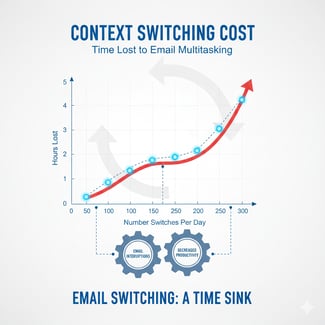
Research shows refocusing takes 30–90 seconds per switch.
With 300–600 email switches per day, teams lose:
👉 4–6 hours daily
👉 20–30 hours weekly
👉 80–120 hours monthly
That’s an entire team member lost — without hiring anyone.
2. Slower customer responses
When the inbox feels chaotic, the customer waits longer.
And every delayed reply feels like poor service.
3. Mistakes increase
Switching between shipments → mixing details
Switching between customers → missing updates
Switching between airlines → missing cutoff times
Errors are a direct outcome of mental overload.
4. Team burnout
Ops teams feel pressure even when they’re working nonstop.
It’s not the workload — it’s the switching.
This is why teams often feel exhausted by 3 PM.
How AI eliminates email context switching
AI doesn’t reduce workload by replying for your team (though it could).
It reduces the chaos.
Here’s how:
1. Smart auto-sorting by email type
AI identifies: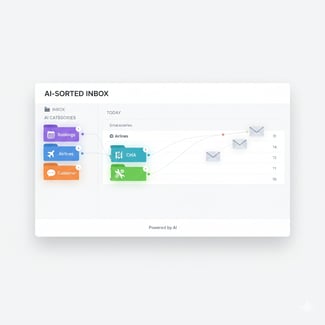
-
Booking confirmations
-
Airline updates
-
Delivery orders
-
CHA messages
-
Customer escalations
-
Finance emails
And instantly sorts them into clean buckets.
Your team never switches between random emails again — they work category by category.
2. Labeling with deterministic accuracy
AI assigns labels like:
-
Customer
-
Airline
-
CHA
-
Accounts
-
Priority
This means no more mental effort in figuring out what type of email just arrived.
3. AI-powered follow-up reminders
No need to jump back and forth checking old threads.
AI tracks unopened, unreplied, and pending emails.
4. Templates for repeated logistics scenarios
CHA doc follow-up
Airline schedule delay reply
Booking confirmation acknowledgment
Commercial invoice request
Fewer decisions → fewer switches.
5. Unified visibility
No switching between tools or tabs.
Everything sits inside the inbox with contextual cues.
The impact: a more stable, predictable, stress-free workflow
When context switching drops by even 40–50%, freight teams report:
✔ Faster replies
✔ Higher customer satisfaction
✔ Fewer errors
✔ More capacity
✔ Happier operations staff
This is why AI is no longer “a nice to have” — it’s becoming the foundation of modern freight operations.
Conclusion
Context switching is invisible, but its impact is massive.
Freight teams aren’t slow — they’re overloaded with unnecessary micro-shifts in focus.
AI finally fixes this.
The companies that embrace this shift will operate faster, leaner, and more profitably than ever before.