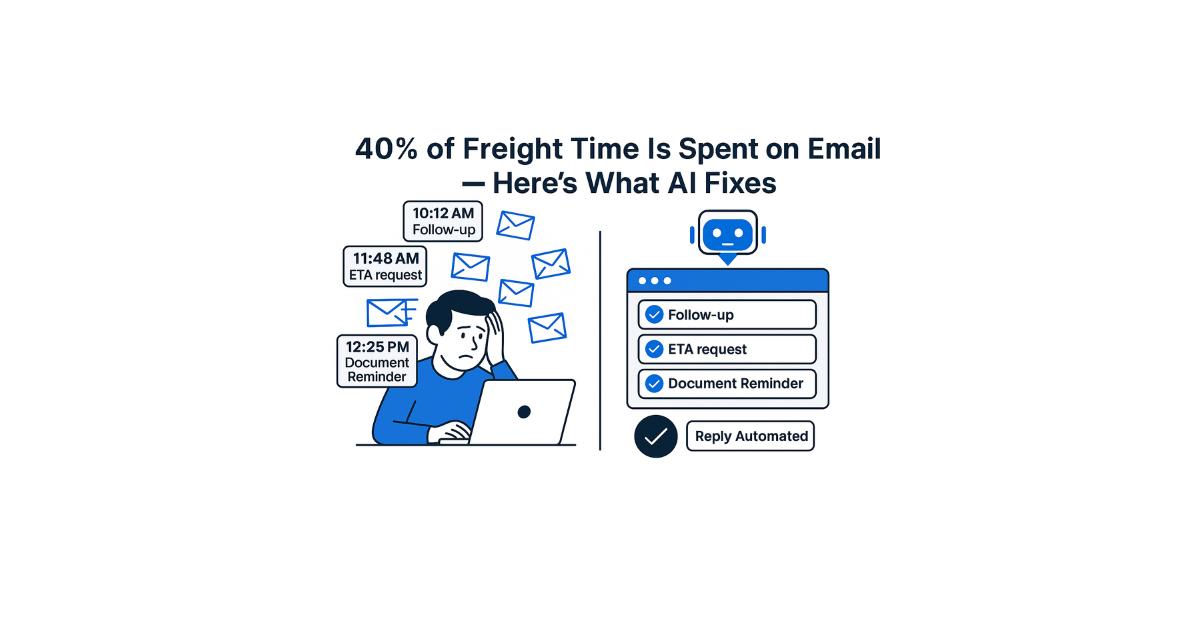


In freight forwarding, speed determines everything — customer satisfaction, shipment movement, and daily operational flow.
But most teams don’t realize one thing:
✅ Freight teams spend up to 40% of their working hours inside their email inbox.
Not on customer service.
Not on operations.
Not on execution.
But on email.
This hidden time sink has become one of the biggest productivity drains in modern freight operations.
And AI is now removing it.
In this article, we break down why email consumes so much time — and how AI is finally transforming the way forwarders and CHAs communicate.
The Freight Inbox Problem: Too Many Emails, Too Many Loops
Freight communication is fast, frequent, and fragmented.
Teams deal with:
-
ETA updates
-
Follow-ups
-
Document reminders
-
Carrier queries
-
Customer updates
-
Regulatory clarifications
-
Internal messages
The result?
✅ Hundreds of emails a day
✅ Multiple long threads
✅ Messages lost inside conversations
✅ Constant back-and-forth
✅ Delays due to missed replies
Traditional email wasn’t built for logistics.
The volume alone slows teams down.
40% of Working Hours Are Lost to Email
A typical forwarder or CHA spends hours every day on tasks like:
• Checking unread messages
• Replying to repeated questions
• Searching old threads
• Locating missing documents
• Sending reminders
• Redirecting information internally
None of this is true operational work.
Yet it consumes a large part of the day.
This is the hidden cost few companies ever measure.
Where Time Gets Wasted (The 4 Biggest Email Bottlenecks)
✅ 1. Repeated Questions
Customers ask the same things:
“ETA update?”
“Docs sent?”
“Vessel departed?”
Manually replying slows teams down.
✅ 2. Searching for Past Conversations
Teams lose minutes (and sometimes hours) digging through old threads to find:
-
BL copies
-
Attachments
-
Previous instructions
-
Shipment IDs
✅ 3. Follow-ups & Reminders
Document reminders, customer nudges, overdue tasks…
All done manually.
✅ 4. Long Email Threads
Miscommunication increases with long threads, resulting in:
-
Missed instructions
-
Misaligned expectations
-
Shipment delays

AI Is Redefining Freight Email Workflows
AI-powered inbox systems like SuperComp.AI eliminate the repetitive manual work that email creates.
Here’s how AI transforms communication:
✅ Auto-Reply for Standard Queries
AI instantly answers routine questions such as:
-
ETA
-
Document status
-
Shipment confirmation
Teams no longer type the same email 20 times.
✅ Shipment-Aware Responses
AI identifies shipment IDs → fetches details → replies with correct information.
✅ Document Retrieval & Auto-Attach
AI finds documents across threads and automatically attaches them.
✅ Task Tracking & Follow-ups
AI handles reminders like:
“Packing list pending.”
“Invoice needed for clearance.”
And sends follow-ups automatically.
✅ Email Categorization & Prioritization
Urgent mails surface immediately.
Non-urgent ones get sorted.
The Result: Faster Ops, Higher Productivity, Zero Email Chaos
Companies using AI for communication report:
✅ 30–50% faster reply times
✅ Lower shipment delays
✅ Better customer satisfaction
✅ Faster cross-team coordination
✅ Less operational friction
✅ Major time savings each day
Teams get time back to focus on actual operations — not inbox management.
Final Thoughts
Email will always play a central role in freight.
But the way teams handle email is changing.
AI is reducing manual work, cutting hours of wasted time, and enabling forwarders and CHAs to operate faster than ever.
The companies that embrace AI-driven communication today will be the ones moving shipments faster tomorrow.
