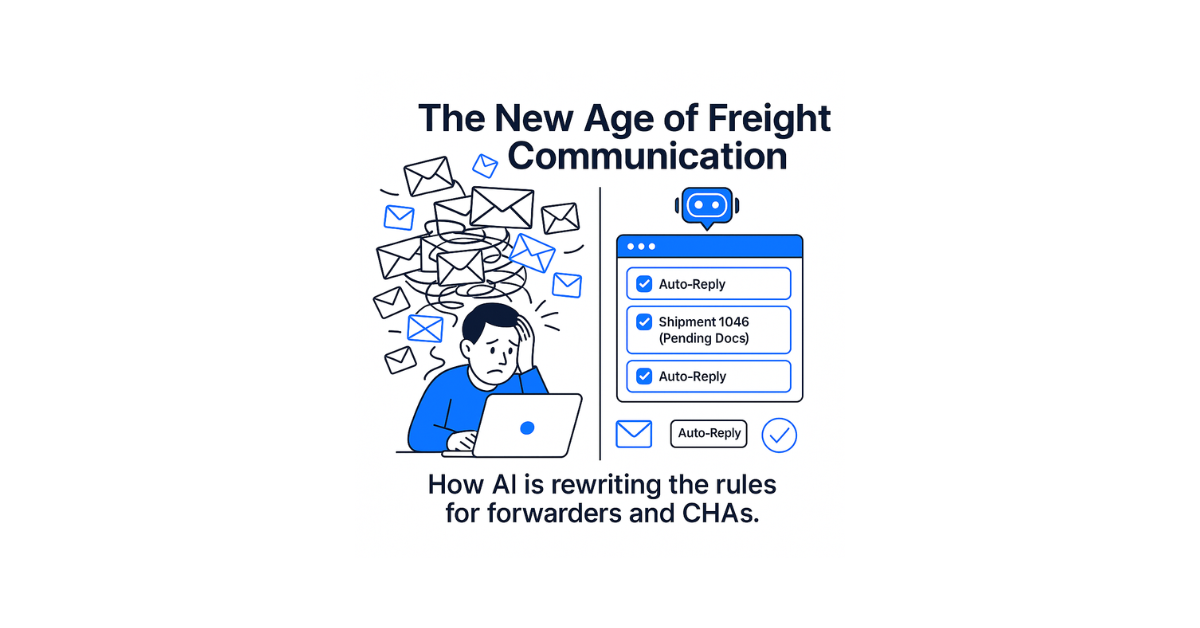


Freight forwarding has always been a race against time — every document, clearance, and email carrying the weight of deadlines.
But what happens when the biggest slowdown isn’t the port, the customs office, or the carrier — but the way teams communicate?
Over the last decade, logistics has digitized almost everything except communication.
Emails still fly in every direction, updates get buried in threads, and teams spend more time searching for information than acting on it.
That’s where AI-driven communication is quietly rewriting the rules.
The Communication Chaos in Freight
Behind every shipment lies a web of coordination — between freight forwarders, CHAs, carriers, shippers, and clients.
But this network runs mostly on email, not structured systems.
The result?
-
Repetitive messages (“ETA update?”, “Invoice copy please”)

-
Missed follow-ups
-
Team overlap and confusion
-
Slower shipment visibility
In a business where one missed message can cost a container slot or trigger demurrage, communication chaos isn’t just inconvenient — it’s expensive.
Why Traditional Tools Can’t Fix This
Most freight companies tried solving this problem with:
-
Shared inboxes — but without intelligence, they just multiply noise.
-
CRMs or ERPs — great for records, not for real-time context.
-
Internal messaging apps — they fragment updates even more.
The truth is, email remains the operational backbone, but it was never designed for the complexity of freight.
It needs intelligence — not replacement.
Enter AI: The Invisible Freight Assistant
Artificial Intelligence doesn’t replace freight communication; it amplifies it.
Imagine if your inbox could:
-
Recognize a shipment reference number and group every related email automatically.
-
Detect duplicate queries and draft ready-to-send responses.
-
Highlight unread or high-priority client messages before they turn into escalation.
-
Show you a dashboard of “who replied, what’s pending, and what’s urgent.”
That’s not futuristic — that’s what next-gen tools like SuperComp.AI already do.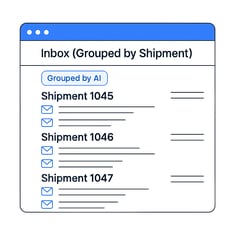
How AI Communication Changes Freight Operations
Let’s break it down into three measurable shifts:
a. From Reactive to Predictive
Traditional inboxes react after the fact — when someone complains.
AI inboxes predict where follow-ups will be needed and surface issues before clients even ask.
b. From Silos to Shared Context
Every team member sees the same communication trail — not scattered across folders or personal inboxes.
That means fewer internal emails and faster coordination with CHAs and carriers.
c. From Manual Replies to Automated Action
Instead of retyping the same “Please find attached” or “Awaiting customs clearance” 50 times a day, AI drafts it for you — freeing humans for exceptions, not repetition.
Real-World Example
One forwarder in Chennai was managing over 80 active shipments weekly.
Each shipment involved 10–15 separate threads — updates, invoices, carrier notes.
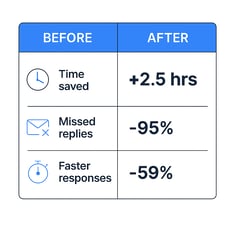
After implementing SuperComp.AI, their team:
-
Reduced average inbox handling time by 43%
-
Cut missed client replies by 65%
-
Delivered faster updates without hiring extra staff
The real impact? Their clients noticed — not because of faster cargo, but faster communication.
What the Future Looks Like
AI isn’t just about speed — it’s about visibility and control.
Tomorrow’s freight teams will have communication dashboards that resemble shipment trackers — showing exactly where every query, document, and approval stands.
And the forwarders who adapt early will win not just shipments, but long-term client trust.
The freight industry has optimized ships, trucks, and routes — but not conversations.
Now, with AI bridging that gap, communication is becoming a competitive advantage.
Freight forwarders and CHAs who modernize today won’t just move cargo faster — they’ll move business forward.
✉️ Ready to experience AI-powered communication for your team?
Visit supercomp.ai/waitlist