

Freight businesses don’t collapse when business is slow.
They struggle when business picks up.
More customers.
More shipments.
More emails.
Yet the core system handling all of this — the inbox — remains unchanged.
For most freight forwarders, email is the invisible backbone of operations. And it’s also the first thing to break when volume increases.
Section 1: growth creates email chaos (without you noticing)
In freight operations, email is not communication — it is execution.
Bookings arrive via email.
Shipping instructions arrive via email.
Invoices, approvals, amendments, delays — all via email.
When volume increases: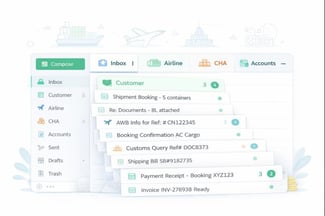
-
One inbox becomes many responsibilities
-
Multiple people touch the same thread
-
Follow-ups are tracked mentally
-
Critical mails get buried under “normal” ones
At this stage, teams don’t feel “inefficient”.
They feel busy.
That’s the danger.
Section 2: why email breaks before any other system
Accounting systems scale.
CRMs scale.
Tracking tools scale.
Email doesn’t.
Traditional inboxes were never built for:
-
Multi-party coordination
-
Shipment-based conversations
-
Operational accountability
-
Missed-email prevention
So teams invent workarounds:
-
Flags
-
Starred mails
-
Excel trackers
-
WhatsApp follow-ups
These work — until they don’t.
Section 3: the hidden cost of losing email control
When inboxes spiral out of control, the cost isn’t just time.
It shows up as: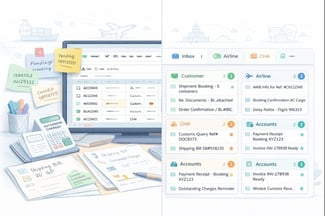
-
Delayed customer responses
-
Missed follow-ups
-
Repeated internal escalations
-
Stress on senior staff
-
Founder dependency
Worst of all, teams stop trusting the inbox.
And when that happens, errors multiply quietly.
Section 4: why freight teams need email infrastructure, not hacks
The solution isn’t more discipline.
It’s infrastructure.
Freight teams need inboxes that:
-
Understand freight context
-
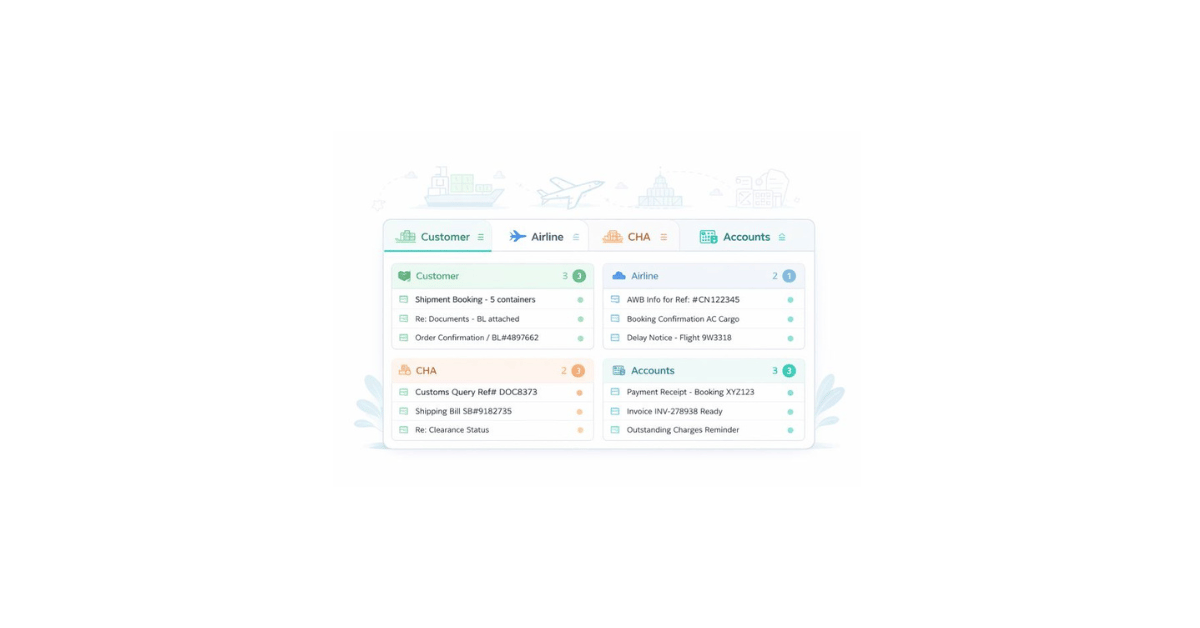
Separate customer, airline, CHA and accounts emails
-
Highlight what’s unread, unattended or overdue
-
Reduce dependency on individuals
-
Work with existing email tools
This isn’t about productivity.
It’s about operational control.
Section 5: fix email before you scale further
Most freight companies wait until chaos forces change.
The smarter ones fix email before:
-
Hiring more staff
-
Adding new branches
-
Taking on bigger clients
Because when email is under control, everything else scales smoothly.
Conclusion
Growth shouldn’t feel like firefighting.
If email is still un-managed, growth will always feel heavier than it should.
The inbox is not just a tool — it’s the control center of modern freight operations
